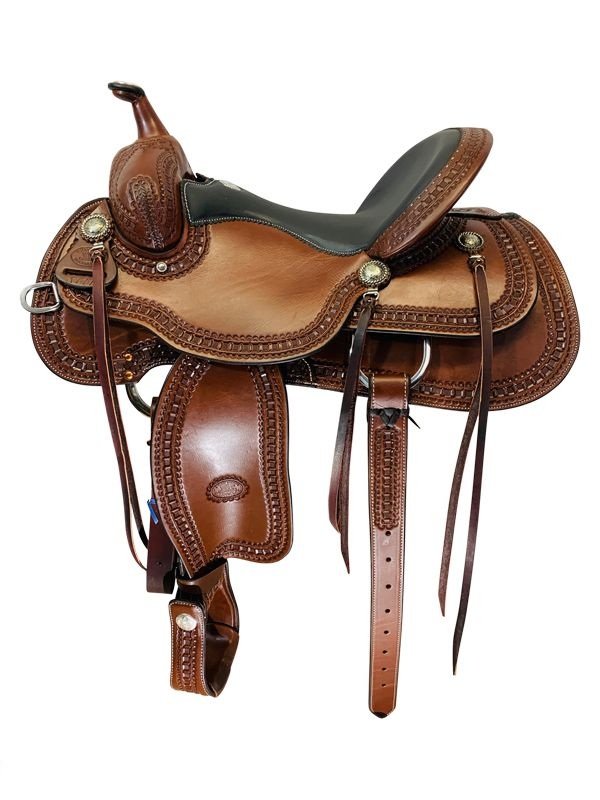
Identify the surface before applying a product
Circle Y’s care guidance treats suede differently from smooth leather: it advises suede-specific cleaning and no oils or conditioners on suede. Roughout can darken with treatment. New Circle Y saddles are already oiled and finished, so the maker does not prescribe immediate routine re-oiling. These instructions are brand-specific, not a rule for every saddle.
| Area | First decision |
|---|---|
| Smooth finished leather | Use maker-approved cleaner and conditioning instructions |
| Roughout | Confirm finish compatibility and expected color change |
| Suede seat or jockeys | Use suede-specific care; keep general oils away |
| Cordura or other fabric | Follow the panel instructions separately |
| Hardware and load-bearing straps | Inspect condition while cleaning; cosmetics do not repair defects |
Build the routine around inspection
A material-aware cleaning session
- Read the instructions and set aside unsuitable products
Match the cleaner to the exact surface. Test a compatible product inconspicuously where the maker advises it; do not experiment across the whole seat.
- Remove loose dirt before treatment
Use the maker’s recommended cloth or brush for that surface. Keep the work organized so suede and fabric are not contaminated with leather oil.
- Clean and dry as directed
For Circle Y leather, the maker advises natural drying in a cool shaded place and no artificial heat or direct sun to accelerate it.
- Condition only the appropriate areas
Follow product and maker directions for amount and frequency. Record what was used so a later color or texture change can be traced.
- Check the tack before returning it to use
Look over straps, stitching, fasteners and damaged areas. Cleaning should not disguise a part that needs assessment or replacement.
Storage is part of the care plan
UF/IFAS Extension emphasizes keeping tack out of hot, humid storage and checking its safety while cleaning. Its general treatment suggestions differ from some maker instructions; follow the exact saddle’s finish guidance instead of combining incompatible recipes.
For a hybrid such as the Big Horn 296, synthetic panels do not eliminate leather care. An owner’s rain-spotting report is a reminder to identify each material, not proof that all fabric saddles are weatherproof.
When care becomes a repair question
Persistent dye transfer, peeling horn leather, torn stitching or a distorted strap deserves a maker or saddler assessment. Do not try to solve a structural or fitting problem by adding more oil. The useful endpoint is clean, appropriately cared-for tack whose condition you understand—not the darkest or shiniest finish.


