Start with the complete bearing shape
A round or shorter skirt can reduce the outer footprint, but it cannot identify the tree’s contour or how it bears on the horse. Circle Y’s fitting guidance treats back length and tree width as separate considerations. A short-backed horse does not automatically need a wide tree.
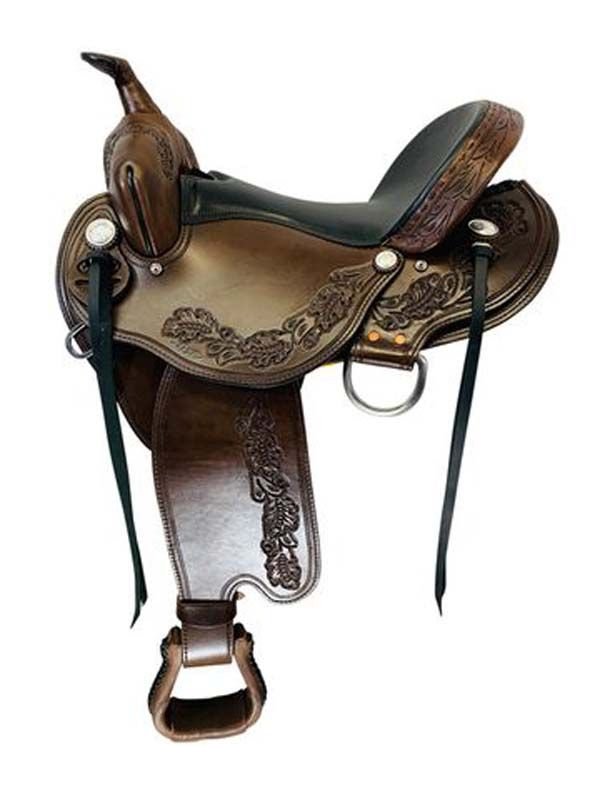
The Big Horn 908, Dakota 213 Circle Y Alpine and Dakota 245 were selected for distinct compact-profile discussions and owner fitting examples. They are not ranked by breed suitability. The Dakota 2214 also has short-back successes, but its own corpus includes bridging and shoulder tightness on a Haflinger; that is why neither a Haflinger label nor a successful story is treated as a guarantee.
Use the rider tradeoff to narrow a successful horse fitting
After the horse-side assessment
- 908: investigate seat firmness and leather readiness.
- 213: check the deep seat and bulk beneath the leg.
- Alpine: check the equipped lift and supplied straps.
- 245: tie the outer measurement to the chosen seat size, then inspect leather readiness and cantle condition.
- Do not continue a trial through unexplained soreness or unstable movement.
The 245 changes length when the seat changes
The captured listing gives 25 inches for the 15-inch seat and 26 inches for the 16-inch seat. It offers a 17-inch seat without documenting that version’s skirt length. Request that measurement instead of carrying the smallest number into a larger-seat order.